
The Federal Aviation Administration says a brief power outage at a Southern California airport's air traffic control tower forced controllers to use portable radios to communicate with pilots and caused a number of flight delays.
Agency spokesman Ian Gregor says the outage Sunday at John Wayne Airport in Orange County lasted a little more than an hour.
Gregor says the tower had been running on an emergency generator since commercial power failed Friday. He says the backup generator stopped working at 11:42 a.m. Sunday, but the tower was able to revert back to commercial power by 1 p.m.
throughout the outage, controllers used radios to guide pilots through landings. Gregor says around 10 departing flights were delayed by a little over a half-hour.
Gregor says FAA technicians have determined what went wrong with the generator and are fixing it.
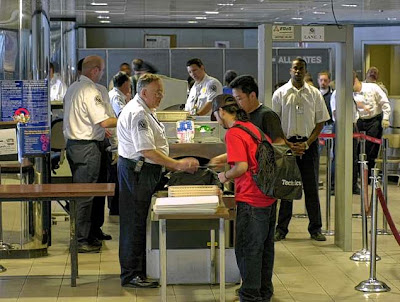
A new passenger screening program to make check in more convenient for certain travelers is being expanded to 28 more major U.S. airports, the government said Wednesday. There will be no cost to eligible passengers, who would no longer have to remove their shoes and belts before they board flights.
The airports include the three used by hijackers to launch the terror attacks in September 2001: Washington Dulles International Airport, Newark Liberty International Airport in New Jersey and Boston's Logan International Airport.
The Transportation Security Administration's program, already in a test phase in seven other airports, is the Obama administration's first attempt at a passenger screening program responsive to frequent complaints that the government is not using common sense when it screens all passengers at airports in the same way. Under the new program, eligible travelers have the option to volunteer more personal information about themselves so that the government can vet them for security purposes before they arrive at airport checkpoints.
"Good, thoughtful, sensible security by its very nature facilitates lawful travel and legitimate commerce," Homeland Security Secretary Janet Napolitano said.
The program works this way: Participating travelers will walk through a dedicated lane at airport security checkpoints. They will provide the TSA officer with a specially marked boarding pass. A machine will read the barcode, and travelers deemed "low-risk," will likely be allowed to keep on belts, shoes and jackets and leave laptops and liquids in bags when being screened.
Not everyone is eligible to participate in the program, which is already being tested at airports in Atlanta, Dallas, Detroit, Miami, Las Vegas, Los Angeles and Minneapolis-St. Paul. Eligible travelers are some of those who participate in American and Delta airlines' frequent flier programs, as well as travelers in three other trusted traveler programs, which do charge fees to participate. About 336,000 passengers have been screened through the program since the testing began last year, according to the Transportation Security Administration.
By the end of 2012, the government expects select passengers in frequent flier programs for US Airways, United and Alaska Airlines to be eligible to participate. The program is expected to be operating in Reagan National Airport near Washington, Salt Lake City International Airport, John F. Kennedy International Airport in New York and Chicago's O'Hare International Airport by the end of March.
"We are pleased to expand this important effort, in collaboration with our airline and airport partners, as we move away from a one-size-fits-all approach to a more intelligence-driven, risk-based transportation security system," said TSA chief John Pistole.
Pistole has said he hopes to eventually test the program at all airports and with all airlines around the country, but that might take years.

 10:19 PM
 Charles dickens
, Posted in
air traffic control tower
,
airport delays
,
airport news
,
California airport
,
U.S airports
,
0 Comments
Charles dickens
, Posted in
air traffic control tower
,
airport delays
,
airport news
,
California airport
,
U.S airports
,
0 Comments

